By Emma Clark, MSW, PMH-C
This blog post covers tips and tricks for managing OCD in the perinatal period and beyond. For a more basic overview of perinatal OCD, see our other blog post Understanding Perinatal OCD: What Parents Need To Know.

At least 3% of birthing and nonbirthing parents will experience OCD during the perinatal period. While research and awareness of perinatal OCD is growing, many people who experience it still feel lonely, ashamed, or hopeless. When you are trapped in an OCD spiral, it can feel overwhelming and almost impossible to stop. But as a perinatal psychotherapist trained in techniques to support people experiencing OCD, I have seen firsthand that there is hope for interrupting the OCD struggle. If you have OCD (or are wondering if the difficulties you are facing fall under the “OCD” umbrella), you have options! There are a variety of helpful treatments and approaches that can help you learn more about what you are going through and ultimately find freedom from the seemingly endless OCD cycle.
This blog includes several helpful, practical tips and tricks to get you started on your journey towards managing your OCD. First, let’s take a closer look at how exactly OCD works:
Understanding the OCD Cycle
The OCD cycle begins with an obsessive thought, often in response to a trigger of some kind. This obsessive thought creates a sense of anxiety or unease that can seem to grow and grow until a compulsion is engaged in. A compulsion may include mental or physical actions such as seeking reassurance, repeatedly checking or counting, avoidance of a trigger, superstition, and/or excessive cleaning or ordering. What makes compulsions so difficult to resist is the temporary burst of relief they provide. However, it is important to remember that this relief is truly temporary—inevitably, the obsessive thoughts and anxiety will return and bring you right back into the cycle.
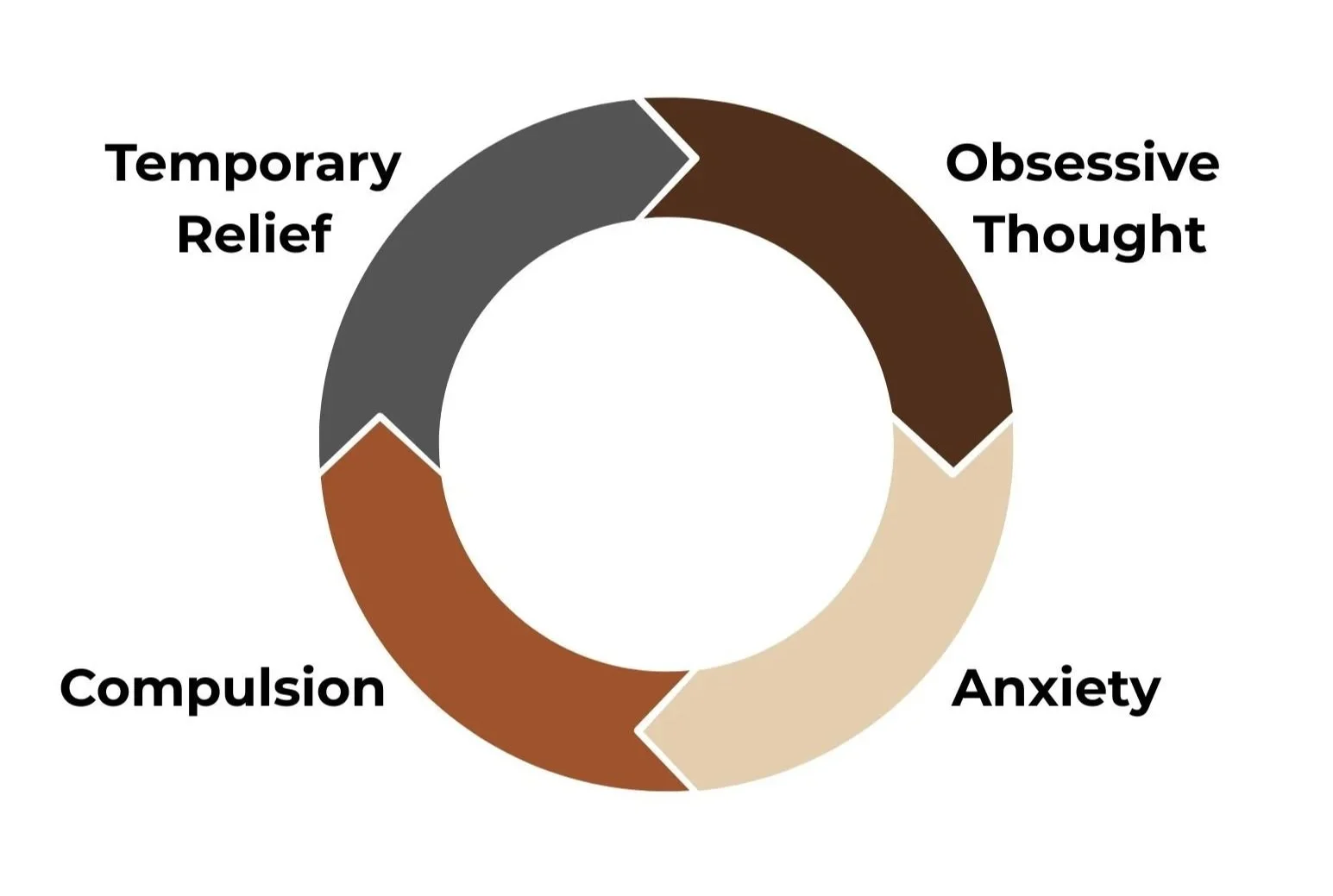
Here’s an example: Jane is six weeks postpartum. One day, she sees a social media post about a worrying medical condition. She becomes convinced that her baby might have this condition and spends all day feeling very anxious. She calls her doctor and receives reassurance that her baby is well, but a few days later, the thought comes back. She continues asking the doctor about this medical condition at every appointment, and spends time Googling potential symptoms between appointments. Reassurance from the doctor and information from the internet give her a little bit of relief, but she never feels totally satisfied with the answer.
Some people understandably worry about how to distinguish compulsions from genuinely helpful behavior. At face value, most compulsive behaviors are neither good nor bad. For example, Jane asking her doctor questions about her baby’s health is a totally appropriate behavior in most contexts. However, when Jane feels that the only way to find relief from her fears about her baby’s health is to repeatedly ask the doctor and check symptoms online (and no amount of reassurance or information can soothe her fears for long), these behaviors have stopped being helpful tools and become compulsions. The goal of OCD treatment isn’t to stop you from ever again engaging in certain behaviors (such as asking questions of a doctor or Googling symptoms), but to expand your freedom to choose how to respond to thoughts rather than feeling controlled by fear and compulsion.
One of the most effective ways to interrupt the OCD cycle is to expand your capacity to tolerate uncertainty and to sit with obsessive thoughts and anxiety without engaging in a compulsion. As you do this, the cycle loses its power, and you gain freedom. The following tips and tricks can support you in your efforts to interrupt the OCD cycle:
#1 Urge Surfing
Urge surfing is a visualization technique that can help you resist the urge to engage in a compulsion, thereby interrupting the OCD cycle.
When you feel your anxiety building, imagine an ocean wave emerging. As you resist the urge to engage in a compulsion, the feeling of anxiety is likely to grow at first, like an ocean wave getting larger and larger.
Imagine yourself as a surfer “riding the wave” of the urge (perhaps with some of the grounding techniques listed later in this post), allowing the urge to be there without immediately trying to soothe it with a compulsion.

Just like how even the biggest ocean waves always crest and fall, as you resist compulsive behavior, you will find that the urge will always subside. Urges and feelings naturally grow, peak, and fall. And the good news is: as you practice “urge surfing” rather than continuing the OCD cycle with a compulsion, you’ll begin to notice that the urges become more manageable over time.
#2 Name The Thought
Naming your obsessive thoughts can also be a helpful tool for managing OCD. Giving a thought a name or title is a gentle reminder that you are more than your thoughts. It can also give your mind some distance from the thought and a moment to pause before acting.
Some simple templates for this include:
“I’m having the thought that ” or “This is my story.”
Here are some examples:
“I’m having the thought that something bad will happen to my baby”
“This is my everything is contaminated story”
“I’m having the thought that I might accidentally harm my baby”
“This is my seeing something sad happen to another family means it will happen to me story”
After naming your thought, you might try one of these tactics:
Try saying: “Thank you, brain!” or “Thanks, but not right now!”
Try singing your thought, or saying it out loud in a funny voice.
While these tactics can seem silly, they can make a big difference in how you experience anxiety-producing thoughts!
While these skills won’t miraculously fix what you are going through, they can help you interrupt anxious thinking. Not every thought or feeling is telling you something true—sometimes they are just passing through. Naming and acknowledging them can help you avoid getting “stuck” on one particular thought or feeling.
#3 Use Your Coping Toolbox
Using a variety of grounding and regulation skills can help you make space for anxiety while choosing not to engage in a compulsion. Here are a few to try:
TIPP Skills:
Temperature - try using temperature to help your body regulate. Most people find cold to be especially helpful (squeezing an ice cube, sipping a cold drink, running hands or wrists under cold water), but warm temperatures (such as a hot drink in your hand) may also be helpful in some moments.
Intense Exercise - engaging in high-intensity activity can help expend anxious energy. If this is not safe for your body right now, skip this tip or experiment with lower-intensity movement.
Paced Breathing - slow your breath down by making your exhales one or two seconds longer than your inhales.
Progressive Muscle Relaxation - do a scan of your body for any tightness or tension, then slowly practice relaxing those spots. You might do this by tensing a muscle (for example, bringing your shoulders as close to your ears as you can) on an inhale, and then relaxing the same muscle as you exhale. Many free Youtube videos can also help you with this exercise.
Distraction:
Sometimes, finding a way to distract yourself from an obsessive thought or urge to complete a compulsion can be helpful. A book to read, a song to listen to, a TV show to watch, calling a loved one, or eating a tasty snack can help you get through an especially difficult moment in the OCD cycle. However, distraction is a less helpful coping strategy if your compulsions include avoiding certain behaviors (such as not changing diapers for fear of contamination, or not calling the doctor due to health anxiety). Consider if or when distraction would be a helpful coping skill for you personally.
Setting a Timer:
When the urge to complete a compulsion arises, try challenging yourself to wait a few minutes before doing the behavior. For example, if you feel the compulsive urge to check that your sleeping baby is still breathing, try setting a timer for 5 minutes before you act. Even introducing a small delay in acting on a compulsion can be helpful to ultimately interrupting the OCD cycle.
#4 Exposure
One of the most effective ways to break the OCD cycle is through exposure. Rather than trying to convince you that your anxious thoughts are totally irrational or unfounded, exposure helps you build confidence that you can handle life’s uncertainties without letting OCD make your decisions. For many people, exposure is best done with the support of a clinician with OCD treatment experience. However, if you feel able, there are ways to experiment with exposure on your own. Some examples of exposure include:
Doing the opposite of what your compulsion would usually be (when safe to do so). For example, if you have an overwhelming fear that wearing black will bring you bad luck, try wearing black. Or if you are afraid to touch a public door handle due to germs, practice doing just that.
Writing down the worst-case scenario story your mind offers you and reading it to yourself multiple times a day for several days. While this may seem counterintuitive at first, most people find that exposing their minds to their greatest fears in this way can actually bring long-term relief. Eventually, you will find that the scenario you’ve written down makes you less and less anxious. You might begin to feel a sense of acceptance that some things in life are uncertain. This is especially helpful if your compulsion is not one you can safely expose yourself to in real life. This technique is called “imaginal exposure,” or exposure using your imagination.
Practicing exposure can cause a lot of discomfort at first. Remember that you are allowed to take breaks, take things slow, and ask for help. Using some of the coping skills listed in step #3 (such as regulating through temperature or deep breathing) can help you manage your discomfort. You’ve got this!
#5 Practice Self-Compassion
Managing OCD during the perinatal period can be incredibly challenging. You may feel overwhelmed or even ashamed by your compulsions, or discouraged about ever overcoming them. No amount of self-judgement will cure your OCD. What can make a real difference, however, is an understanding of the OCD cycle, expanding your coping toolkit, seeking professional support (such as therapy and/or medication, when needed), and offering yourself compassion as you go.
Some self-compassion phrases to try incorporating into your life include:
“I’m doing the best I can.”
“May I be kind to myself.”
“I’m going through something really hard right now.”
“I accept myself as I am in this moment.”
“May I offer myself the compassion I deserve.”
You are not alone in your experience with perinatal OCD. A variety of helpful strategies and treatments exist to help you break the OCD cycle and gain freedom to live a meaningful life not dictated by fear and compulsion. With practice and the right support, this freedom is possible. If you or someone you love is seeking additional support in their journey with OCD, our team at the Perinatal Mental Health Center of Chicago is available to support you. Reach out to us today for more information!