Interview with the Doulas on our Team
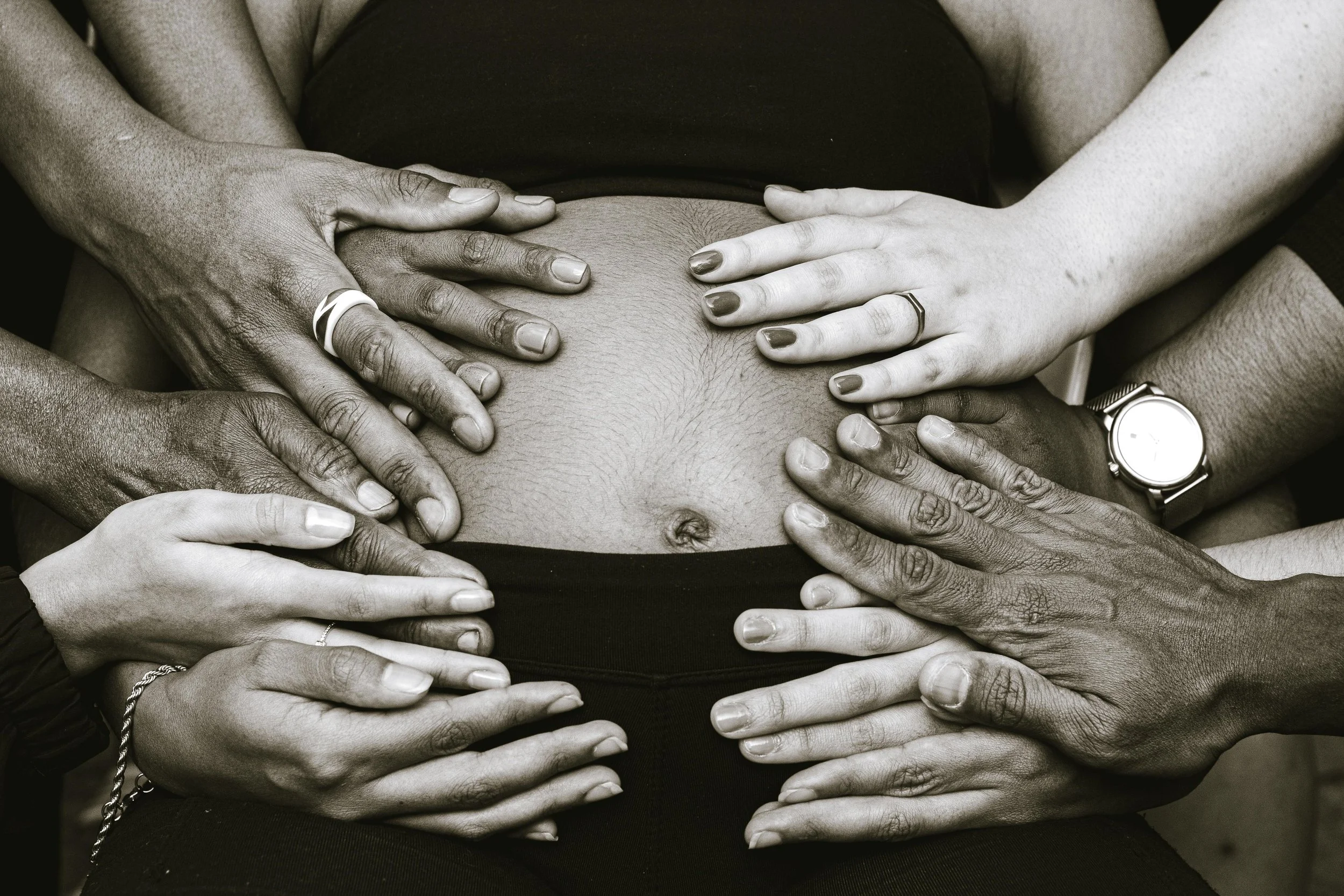
The path into perinatal work is often deeply personal. For four of our clinicians at the Perinatal Mental Health Center of Chicago, training and working as birth and postpartum doulas has been a vital part of that journey. In this post, Jen, Elle, Rachel, and Emma reflect on how they became doulas, how this work led them to become perinatal therapists, and how their doula experience continues to shape their therapeutic work today.
Why did you choose to become a doula?
Jen: A friend of mine asked me to photograph her home birth when I was in my early twenties, and I thought, “Sure, why not?” It ended up being an absolutely life-changing experience for me. Later that year, I became a doula and have now supported countless families through the transition from pregnancy to postpartum. What an absolute treasure to soak up all that is the power and resilience of birthing people. Lately, I have been doing it more for friends and family, and then to watch these kids grow up; ugh, what an absolute delight!
Elle: Simply put, I was always fascinated by pregnancy and birth. Since childhood, I felt a natural pull toward pregnant people and babies. This fascination first manifested as a career in early childhood education. Then, during undergrad, I minored in Child Advocacy Studies, where I learned about epigenetics and birth injustice. After just one class, I knew I wanted to support even younger children, those in utero, those hours old, and the people caring for them. My mother was a teen mom, and hearing about her postpartum experience made it clear she needed far more support than she received. This is what drew me to postpartum doula work after spending a year as a birth doula.
Rachel: What I learned about early childhood development, attachment, and epigenetics in my MSW program validated something I always felt in my core to be true: parents have one of the hardest and most important jobs in the world. They are responsible for shaping the future of our world, and if we want society to be well, we must pour everything we have into supporting those on the “front lines.” When I discovered the role that doulas played in tangibly supporting folks during these pivotal transitions into parenthood, it felt like such an obvious path for me.
Emma: As an undergraduate sociology major, I took a class on the experiences of incarcerated women. When I learned in this class about the devastating reality of giving birth behind bars, I felt a strong pull to learn more about the pregnancy, birth, and postpartum experiences of incarcerated women and other marginalized people. At the same time, I was spending hours on end with my two adorable nieces, who were both born with the support of a doula. I finally decided to take the leap and participate in a birth doula training, and it revolutionized my way of thinking and interacting with the world. A few years later, I also trained to be a postpartum doula, and I love supporting and witnessing new babies and their caregivers. It is such an honor to be invited to be a part of the perinatal experience as a doula!
What is your favorite thing about being a doula?
Jen: My favorite part is the moment when the birthing person needs to lean on my grounded energy to get through a tough moment. The energetic syncing up that happens, usually during transition, is something that never ceases to amaze me. I also love incorporating partners and watching them start to understand how to better support their partners, even if it is their first time.
Elle: My favorite part about being a doula is that it is humans treating humans. I feel grounded in my indigenous roots every time I step into my doula role. One of my favorite songs is Pocahontas - Colors of the Wind. There is an incredible lyric, “and we are all connected to each other, in a circle, in a hoop, that never ends.” I firmly believe if we want a better world, we need healthier humans, and that begins in the perinatal period. It is a period every human has been in, whether as a parent or an infant.
Rachel: Getting to share in a family’s most intimate and vulnerable moments during the perinatal period is such an honor. I still can’t believe it’s real every time I get to attend a birth! It’s pure magic. As a postpartum doula, I really appreciate how hands-on and practical a lot of the work is. It’s often not glamorous, yet it feels so tender because of the impact it makes. The laundry that’s folded or the food that’s prepped means that an overwhelmed, exhausted parent gets to have an easier day and feel like they have a little more gas in their tank to take on all the challenges ahead.
Emma: Shortly after becoming a doula, I started a job as a maternal and child health specialist at a refugee resettlement organization. Because of that, most of my experiences supporting people perinatally have been with individuals and families from all over the world, many of whom speak a language other than English. My favorite thing about supporting these families was witnessing and participating in experiences that transcended language barriers. Laughter, tears, a gentle touch, a smile, and cooing over a new baby connected us across cultures, backgrounds, and languages. Even when working with people with similar cultural backgrounds to my own or who speak my same language, I still find that there are moments of connection beyond words. I cherish all of these!
How did your experience as a doula influence your decision to become a therapist?
Jen: I say this all the time, but being up at 3am and on-call, is not life for me. I give all doulas their flowers! It is really hard! If I could be a doula from 9-5 M-F, I would… and then I’d have to find extra time to be a therapist ;) But, in all seriousness, I love supporting perinatal people of all kinds, and becoming a social worker was a way for me to do that more sustainably for my life. In school, I worked with parents impacted by chronic illness in a community setting and then moved to medical doing postpartum psychosocial assessments. After graduating, I was hired on staff to do outpatient pediatric and obstetric social work. In 2019, I became a therapist specializing in perinatal mental health and started PMHC Chicago in January 2024. What an amazing ride–all built from that first birth experience.
Elle: It's interesting, because for me, being a therapist was always a major goal. When I learned what a doula was, I knew it would make me a better therapist. At the time, I thought, "I want to be a therapist, a good one. One who has the wealth of knowledge gained in trainings and education, and one who has been there with birthing and postpartum people through their vulnerability, in their homes, in a hospital gown…" I wanted to dive deep, and I still do!
Rachel: In my work as a doula, I found that many of the parents I supported struggled with their mental health during the perinatal period. As a doula, I felt somewhat limited in the level of support I could provide without therapeutic expertise. Having a background as a social worker and then as a doula, merging the skill sets and expanding my clinical knowledge felt like a natural next step for me to take to go deeper into this work.
Emma: My experiences as a doula taught me that I definitely wanted to be working with perinatal individuals and families in my career as a social worker. I love learning new ways to do this! Learning how to work with perinatal people in a therapeutic capacity has been a welcome challenge and a joy.
How does being a doula impact your therapeutic work?
Jen: I really see being a doula and a therapist very similarly. It’s not about me being the hero, it’s about my clients knowing that they can do it and have everything they need inside them already. I just get to help them realize that. Those moments therapeutically (and in the labor room) are the most incredible.
Elle: It has impacted my therapeutic work in many ways. I think one of my biggest current reflections on this is introducing the idea of prepping for birth and postpartum, while also exploring what it might be like if we had to let all of that go. I often say to clients, "There is the birthing experience you plan for and then the one you have, and they meet at unexpected intersections." With my background as a doula, I am able to hold the framework of the birthing space, especially by utilizing the somatic experiences clients may have had. It has also continuously grounded me in the fact that only the client is the expert in their own life, just as only the birthing person is the expert in their own birthing experience. It continuously reminds me how much of an honor it is to be a perinatal worker.
Rachel: Through my work as a doula, I have a much better understanding of the challenges new parents face. I’ve helped with preparation during pregnancy, witnessed the intensity of the childbirth experience, and spent hours and hours with families in their homes postpartum. As a therapist, I’m not physically in the moment with folks like I was as a doula; I’m often hearing about it after the fact and get to support with the exploration of what those moments mean to them. While the stories and situations are familiar, the tools I use to support clients take a different shape.
Emma: Being a doula taught me a skill I rely on constantly as a therapist: how to be present to other people’s pain and struggle without rushing to “fix.” As a doula, I could provide hands-on support and guidance to ease some of the difficulty, but only my client could do the work of birthing their baby! Often, the same is true in a therapy session. I trust that the people I work with are capable and powerful, and most often need a compassionate witness to their experience. To my doula and therapy clients, I strive to be able to say: “I see you. I’m here with you. I know you can do this.”
How has moving between these two worlds shaped your understanding of gaps in perinatal care? What systemic issues do you see repeatedly impacting birthing people’s mental health?
Jen: Generally speaking, I do think medical settings can work to be more in tune with the mental well-being of their patients. We know the EPDS is utilized, but it sometimes is not read. And, if it is read, it’s often after the patient has left the building, or, the provider doesn’t feel comfortable having a mental health-related conversation with a patient. This is, of course, where we would love to come in!
Elle: This is such a great question… There is so much to say about this, but I will leave it with an experience I had recently that when I shared with others, they had a similar experience... the, what feels like, gatekeeping of certain information. When I was preparing for the birth of my first child, my partner, who is not a birthworker, was committed to having as much education as possible. We went to a breastfeeding class, and there was NO information on pumping. In fact, the breastfeeding educator made an active choice not to speak about pumping. As a perinatal worker, I knew this was a large gap, and then as a mother who struggled with breastfeeding, I held a lot of complex feelings about what I wish had been taught to me when my family was actively seeking that information.
Rachel: In both worlds, I’m reminded of the vital importance of autonomy in the perinatal experience and how still so many folks are not getting to access this with their care providers. The countless stories of birthing people feeling rushed, ignored, manipulated, and powerless during their birth experience is so disheartening. While it’s not realistic for providers to be able to give birthing people the exact birth they hope for, of course, there are so many opportunities to make space for autonomy and choice, even when unexpected challenges arise.
Emma: There is so much to share here, but I think one of the greatest challenges is a lack of trust in perinatal people. So often, their concerns are not taken seriously, comprehensive and nuanced education is not provided, natural processes are rushed, and people’s decisions about their bodies are not respected. Every perinatal person may have unique needs and circumstances, but all of them deserve to be treated as competent people who are doing the best they can with the resources they have.
How do you care for yourself now, knowing what you know about trauma, burnout, and nervous systems?
Jen: Many of my clients already know this about me, but I am very committed to my yoga practice and utilizing therapy for myself. Getting good rest and cuddling my dog always helps, too!
Elle: I enjoy time outside a lot, it recharges me. I also enjoy laughing with friends, a belly laugh with my people can reset my whole day.
Rachel: Dancing and singing are hobbies of mine that allow me to feel in my body and have somewhere to put all the energy I absorb throughout the day. I also have two perfect cats to cuddle every night!
Emma: I find a lot of catharsis and healing through films and music! Sometimes watching or listening to something that gets me in my feelings for a bit can help me process and move forward.
How do you ethically hold or separate the identities of doula and therapist, if you still engage in both?
Jen: I think being a doula gives me some credibility with clients. They know that I have seen some stuff and experienced a variety of birth experiences and birthing settings. This helps build rapport when a client is feeling unsure or nervous about birth or those early postpartum days. However, I am careful to wear the appropriate hat at the appropriate time. I would say my work as a doula informs my practice as a therapist and allows for more tangible birth prep and postpartum planning to occur. As well as, helps with referral recommendations for clients based on what kind of doula or support they might be looking for during or after pregnancy.
Elle: My doula work often comes up in the therapeutic space; in fact, it is sometimes a key aspect that encourages clients to work with me. It is a great honor when a doula client asks if I can be their therapist, or when a therapy client asks if I can be their doula. However, there are clear protective boundaries for everyone involved that make dual roles inappropriate, and those moments become a beautiful opportunity to refer people to other incredible birthworkers in the community.
Rachel: I feel like I am able to flex some practical knowledge I’ve gained as a doula when it is relevant to supporting a therapy client in preparing for birth or settling into life postpartum, while keeping the focus on our therapeutic work. In both directions, referring folks to other birth professionals so that I am not serving as both is a useful lever.
Emma: My experience as a doula always informs my work with pregnant and postpartum folks and helps me be more effective and detailed when supporting birth and postpartum planning. With that said, my responsibility as a therapist is a bit different! The skills I use to help explore and support the emotional worlds of my clients are different from the ones I would use to physically support a client through birth or postpartum. I encourage clients to look into having a hands-on doula in addition to a therapist, when possible.
Note: there are other kinds of doulas including: Birth Doulas, Postpartum Doulas, Fertility Doulas, Abortion Doulas, Death Doulas, Transition Doulas. We explore only two kinds here.